Dubai Real Estate Market 2025: Annual Review, Property Prices and Investment Trends
Explore Dubai real estate market trends in 2025, including AED 917 billion in transactions, property prices, off-plan sales, land investment and rental growth.
Executive Summary: Dubai Real Estate Market in 2025
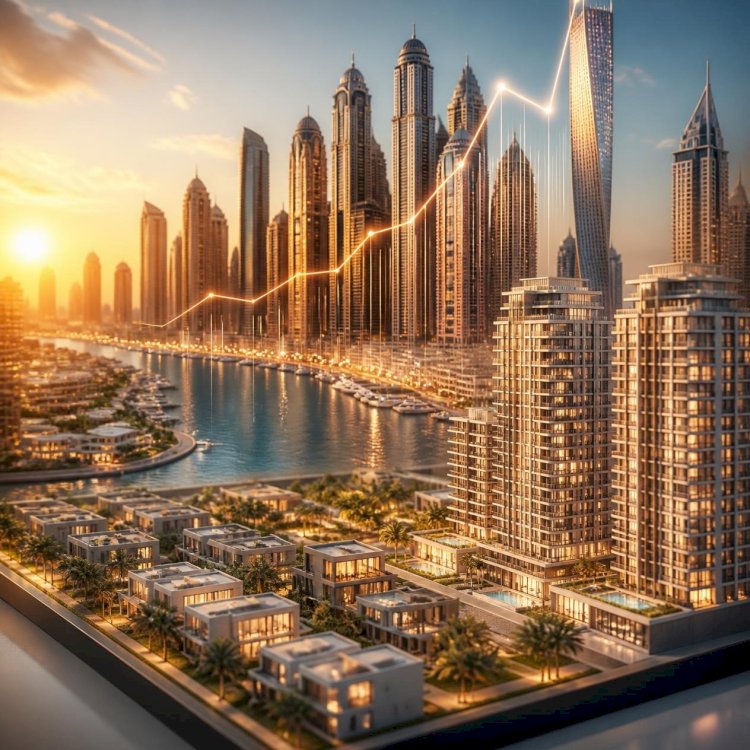
The Dubai real estate market entered a new phase of scale and maturity in 2025, supported by strong transaction activity, growing investor participation, expanding rental demand and continued property development. The market's performance further reinforced Dubai's position as a global destination for real estate investment, business and international capital.
According to the figures presented in this annual review, Dubai recorded 270,328 real estate transactions in 2025, representing a 20% increase compared with 2024. Total transaction value also rose by 20%, reaching AED 917 billion.
Beyond transaction growth, the Dubai property market demonstrated depth across residential and commercial real estate, off-plan developments, existing properties, land transactions and rental registrations. A broad international investor base, established regulatory infrastructure and continued urban development supported the emirate's investment appeal.
This annual review examines the key indicators shaping Dubai's real estate market in 2025, including transaction volumes, investor demographics, property prices, off-plan sales, land investment and rental market performance.
1. Dubai Real Estate Transactions and Market Value
Dubai's real estate market maintained strong momentum throughout 2025, with transaction volumes and total transaction value both increasing by 20% year-on-year.
The market recorded 270,328 real estate transactions with a combined value of AED 917 billion. Sales represented the largest transaction category, accounting for 217,889 transactions valued at AED 680 billion.
Mortgage registrations reached AED 180 billion, while gift transactions accounted for AED 57 billion.
These figures highlight the scale of Dubai's property market and the range of activities supporting its continued expansion. The combination of property sales, mortgage activity and transfers reflects a market in which residential and commercial assets continue to attract substantial investor interest.
For property investors, however, aggregate transaction growth is only one part of the analysis. Asset selection, acquisition pricing, rental income potential, liquidity and exit strategy remain essential considerations when evaluating individual investment opportunities.
2. Dubai Property Investment: Investor Growth and Capital Flows
Investor participation expanded significantly in 2025. The number of unique real estate investors increased to 193,100, compared with 156,149 in 2024.
Total investment value reached AED 680 billion across 258,554 investments.
New investors contributed AED 348 billion, while repeat investors accounted for AED 332 billion. This distribution highlights two important dimensions of the Dubai real estate investment market: its ability to attract new capital and its capacity to retain participation from existing investors.
The balance between new and repeat investment is relevant when assessing market continuity. New investors can expand demand across different property segments, while repeat investors may reflect continued confidence in the market and opportunities to diversify existing portfolios.
Nevertheless, investment volumes alone do not establish future price appreciation or guarantee returns. Investors should assess the financial characteristics, ownership costs and exit liquidity of each property independently.
3. International Investors in Dubai Real Estate
Dubai continued to attract a geographically diverse investor base in 2025, reinforcing its role as an international real estate investment hub.
Asia and Europe together contributed nearly AED 496 billion in investment value. South Asia remained the largest source region, with 52,348 investors contributing AED 123.3 billion.
Female participation also increased. The market recorded 63,577 female investors, with a combined investment value of AED 154 billion, representing a 31% year-on-year increase.
These figures illustrate the breadth of investor participation in Dubai property and the importance of international capital to the emirate's real estate ecosystem.
For international buyers, Dubai's appeal can extend beyond property ownership itself. Factors such as business connectivity, residential infrastructure, international accessibility, residency options and portfolio diversification may all influence acquisition decisions.
However, investor origin and aggregate investment value should not be interpreted as a direct measure of future demand for every neighbourhood or property category. Local market conditions and the intended use of each asset remain important.
4. Off-Plan Property Sales, Existing Properties and Land Investment
Off-plan real estate remained a major component of Dubai's property investment activity in 2025. Its share increased to 63.3%, compared with 61.0% in 2024.
This trend reinforces the role of new residential and commercial developments in the expansion of Dubai's real estate market.
Existing properties also maintained significant market activity, recording a transaction value of AED 312.2 billion. Vacant land transactions reached AED 309.7 billion, highlighting the importance of land as a distinct investment category.
These segments serve different investment objectives.
Off-plan properties may appeal to buyers seeking newly developed assets, staged payment structures or exposure to future project completion. Their investment characteristics depend on the developer, contractual terms, construction progress, delivery timeline and the relationship between purchase price and comparable market values.
Existing properties allow investors to assess a completed asset, its location, physical condition and potential rental performance. In suitable cases, they may also provide a more immediate route to occupancy or income generation.
Land investments require a different analytical framework. Zoning conditions, permitted uses, infrastructure access, development potential, acquisition costs and the intended investment horizon can significantly influence a parcel's value.
For investors considering Dubai land investment, the headline transaction value of the market is not a substitute for parcel-level due diligence. Each opportunity should be assessed according to its legal status, development parameters and realistic exit scenarios.
5. Dubai Property Prices in 2025
Property price indicators continued to rise across the categories covered by this review.
The reported average prices in 2025 were:
Residential units: AED 20,666 per sq. m.
Residential villas: AED 16,791 per sq. m.
Commercial units: AED 22,119 per sq. m.
Commercial villas: AED 20,480 per sq. m.
These figures provide a broad overview of price levels across different property categories. They should not, however, be treated as directly comparable valuations for individual assets without further information about location, property type, size, condition and the underlying calculation methodology.
Dubai's real estate market comprises a wide range of neighbourhoods and development types, each with its own supply, demand and pricing dynamics.
For residential investors, the analysis should consider location, service charges, rental demand, competing supply and potential resale liquidity.
For commercial property investors, additional factors may include tenant quality, lease duration, occupancy, operating expenses and the relationship between rental income and acquisition cost.
A meaningful investment decision therefore requires more than an average price per square metre. It requires an assessment of the individual property's financial performance, competitive position and intended holding period.
6. Dubai Rental Market: More Than One Million Contracts
Dubai's rental market continued to expand in 2025, with rental contracts exceeding one million for the first time. The total annual rental value reached AED 98.9 billion.
This milestone underlines the importance of leasing activity within Dubai's broader real estate ecosystem.
For investors evaluating income-producing properties, rental market performance is an important part of the acquisition decision. Yet the number of registered contracts and aggregate rental value do not, by themselves, establish the net return available from a particular property.
A more complete rental investment assessment should consider:
Achievable market rent and the property's competitive position.
Occupancy assumptions and potential vacancy periods.
Service charges, maintenance and other operating expenses.
Property management costs and leasing fees.
Acquisition costs, financing and the expected holding period.
Potential resale demand and exit liquidity.
Investors comparing off-plan and completed properties should also distinguish between projected rental income and income supported by actual leasing evidence.
The objective is to evaluate sustainable net income rather than rely solely on headline rents or market-wide growth figures.
7. Dubai Real Estate Market Outlook: Key Factors for Investors
Dubai's 2025 real estate performance reflects a market supported by substantial transaction activity, international investor participation, new development and an expanding rental sector.
The emirate's regulatory framework, digital infrastructure, residency policies and continued investment in urban development remain important elements of its international positioning.
Nevertheless, market-wide growth does not eliminate investment risk. Property supply, acquisition pricing, financing conditions, developer performance, rental competition and the timing of resale can affect the outcome of individual investments.
Investors should therefore distinguish between the strength of the overall market and the financial suitability of a specific asset.
A disciplined acquisition strategy should establish:
The investment objective, whether personal use, rental income, capital appreciation or portfolio diversification.
The property's position relative to comparable assets and competing supply.
The full acquisition and ownership cost.
Realistic rental, resale and holding-period scenarios.
The legal, contractual and operational risks associated with the investment.
Dubai offers a diverse range of residential, commercial and land investment opportunities. The most appropriate choice depends on the investor's objectives, financial capacity, risk tolerance and investment horizon.
Conclusion: Understanding Dubai Real Estate Beyond Market Growth
The Dubai real estate market in 2025 demonstrated substantial transaction activity, a broadening investor base, continued off-plan development and further expansion in rental registrations.
The reported figures provide valuable context for understanding the scale and structure of the market. For investors, however, the next step is to translate these market-wide indicators into an asset-specific investment assessment.
Property location, acquisition price, income potential, ownership costs, legal conditions and exit liquidity should all be considered before making an investment decision.
As Dubai continues to strengthen its position as a global business and investment destination, a disciplined approach to property selection and financial analysis remains essential.
The central question for real estate investors is not simply how much the Dubai market has grown, but which assets offer the strongest fit with their investment objectives and risk profile.
Ozkan OZEL
Strategic Real Estate Asset Management
Besiktas / Istanbul
ozkanozel.com/en
What's Your Reaction?